Streamlined Configuration Solution for Industrial Robotics
- DX Strategy
- Feb 28, 2023
- 5 min read
Updated: Mar 28

Timeline: 2022.05-2023.03
Client: Kawasaki Heavy Industries (KHI)
Role: Creative Director, UI/UX Designer
Executive Summary
Objective: Scaling the Unscalable
KHI aimed for an ambitious 7x sales growth, but their traditional model hit a wall because every deal required a senior engineer on-site. My mandate was to build a Robotics Sales Platform that decouples revenue growth from engineering headcount.
The "Expertise Bottleneck"
We identified three critical friction points in the robotics sales cycle:
Hard to Scale (KHI Engineers): Buried in manual site verifications, creating a massive bottleneck that capped growth potential.
Hard to Propose (Business Partners): Lacked technical expertise to configure robots independently, acting as passive messengers rather than consultants.
Hard to Visualize (Factory Owners): Couldn't judge if a robot would physically fit their messy facility, leading to hesitation and stalled deals.
Solution: A Self-Service Ecosystem
A LiDAR-enabled iPad application that shifts technical verification from humans to software. It functions as a Site Scanner for data collection (to capture "Digital Twin" of the factory) while acting as an Automated Consultant for partners (to configure and validate solutions instantly).
This project was officially debuted as a core solution for KHI’s RoboCross platform at the 2023 International Robot Exhibition (iREX). Press Release
Research & Empathy
To understand the ecosystem, we mapped the needs of the three key stakeholders:
The Customer: Owner of a radish processing factory. He faces labor shortages and slippery/cold working conditions but lacks technical robot knowledge. He struggles to provide the necessary facility information remotely.
The Integrator: A business partner responsible for installation. He needs clear requirements to create proposals but often receives vague information, leading to rework.
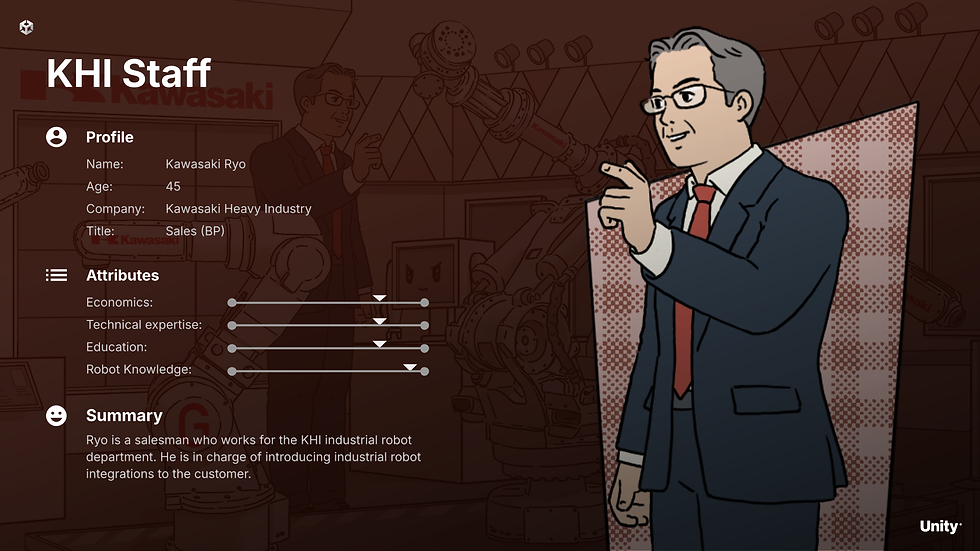
The KHI Staff: The bridge between all parties. He spends excessive time clarifying requirements and coordinating site visits, leaving little time for proactive sales.




The Friction: Current User Journey
We analyzed the existing workflow and identified specific "Pain Points" that were slowing down the cycle:
Pain Point A (Maintenance): When malfunctions occur, diagnosing the cause takes too long due to poor information flow.
Pain Point B (Verification): Integrators expend massive effort verifying customer environments physically to gather data for proposals.
Pain Point C (The Bottleneck): Most Critical. When a new lead comes in, KHI staff must manually intervene to create a proposal. This dependency on KHI staff effectively capped the number of leads the company could process simultaneously.


Solution
Proposed User Journey: Breaking the Bottleneck
To scale the business, we couldn't just "speed up" the existing process; we had to restructure it. We redefined the roles of KHI Staff and Integrators to remove the dependency on KHI's internal resources.
The Strategic Shift:
Integrator (Empowered): Previously passive, the Integrator now takes full ownership of the first three critical steps: 1. Gather Requirements, 2. Identify Robot, and 3. Proposal. Armed with the new platform, they can execute these tasks without KHI's direct supervision.
KHI Staff (Optimized): Freed from the time-consuming proposal phase, KHI staff can now focus on high-value tasks: Confirmation, Training, and After-service.
Business Value
This new flow allows Business Partners to be involved from the very early stage of a lead. By offloading the initial "consultation" work to the software and partners, we drastically reduced the effort required from KHI staff, enabling them to process significantly more deals simultaneously.

The Solution: A Self-Service Ecosystem
To bridge the gap between complex engineering needs and sales efficiency, we developed a LiDAR-enabled iPad application. This tool transforms the sales process into a self-service ecosystem, empowering customers and partners to handle technical tasks that previously required senior KHI engineers.
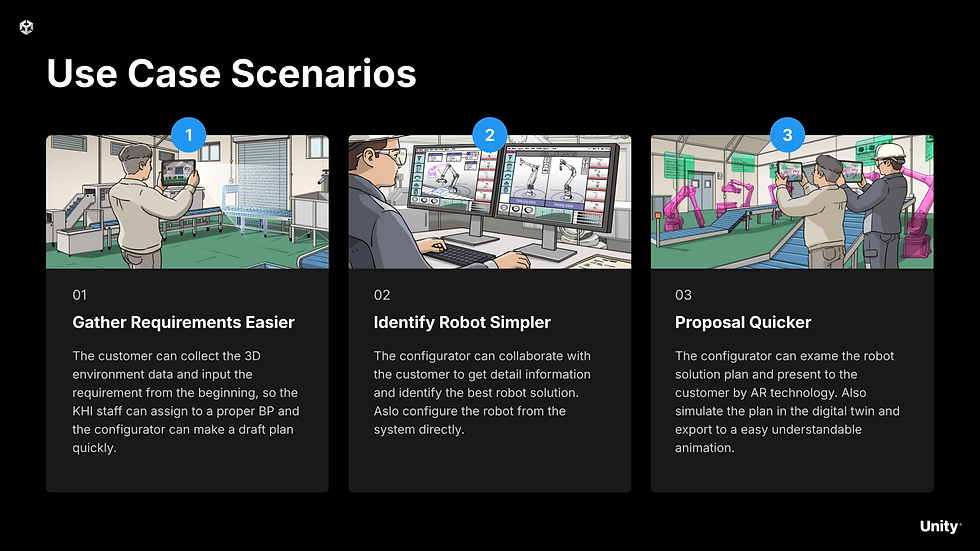
The solution is structured around three key scenarios:
01. Gather Requirements Easier (Digital Twin Capture) Instead of waiting for an engineer to visit, the customer can now use the iPad’s LiDAR scanner to collect 3D environment data of their factory.
How it works: The app captures a "Digital Twin" of the facility and inputs requirements from the very beginning.
Benefit: This precise data allows KHI staff to assign the most suitable Business Partner (BP) immediately, and the system can automatically generate a draft plan based on the scanned environment.


02. Identify Robot Simpler (Automated Configuration) The application acts as an intelligent configurator, enabling partners to identify the best robot solution without needing deep technical expertise.
How it works: The configurator collaborates with the user to refine details and selects the optimal robot model. Users can configure the robot (e.g., end-effectors, mounting positions) directly within the system.
Benefit: It shifts the role of partners from passive messengers to active consultants who can validate technical feasibility on the spot.


03. Proposal Quicker (AR Visualization & Simulation) We replaced static paper proposals with immersive, interactive experiences to help factory owners visualize the value instantly.
How it works: The configurator examines the solution and presents it using AR technology, overlaying the digital robot into the real factory space. It also simulates the operation within the digital twin and exports an easily understandable animation.
Benefit: This removes hesitation by allowing clients to "see" the robot working in their messy, crowded factories before purchasing, significantly shortening the deal cycle.


Design & Prototype
Instead of a lengthy development cycle with uncertain outcomes, we adopted a Rapid Prototyping strategy to validate the business case directly with KHI's leadership.
The Strategy: Show, Don't Just Tell
We built a high-fidelity functional prototype using Unity to demonstrate the core "Self-Service" concept. The goal was to prove to KHI executives that a complex engineering task could indeed be simplified into an intuitive iPad experience.
The Outcome: Securing the Future
The prototype served as the ultimate proof of concept.
Tangible Vision: It transformed the abstract idea of "Digital Transformation" into a concrete, playable reality that stakeholders could see and touch.
Immediate Greenlight: The demonstration was so convincing that it validated the feasibility of the scaling model instantly.
Business Success: The success of this prototype directly secured the contract for the next phase of the project, proving that the design solution aligned perfectly with KHI's strategic growth goals.


Reflection
1. Prototyping as a Negotiation Tool
The hardest part of any project is moving stakeholders from "Why?" to "How?". This project proved that a functional prototype is the most effective tool for alignment. It translated abstract 7x growth targets into a concrete operational roadmap.
2. Democratizing Expertise
The project's true value lay in Decoupling Revenue from Headcount. By embedding senior engineering expertise into a mobile platform, we created a model where KHI can scale through its partner network rather than its own internal hiring. This shift from "Human-Dependent" to "System-Dependent" is the cornerstone of scalable digital growth.
3. Trust is the Ultimate Business Metric
While traditional UX focuses on user satisfaction, this project focused on Stakeholder Trust. The fact that KHI committed to the next phase immediately after seeing the prototype is the strongest validation possible. It confirms that design can be a primary driver for winning trust and securing multi-stage consulting engagements.
Comments