Obayashi CPS Envisioning Workshop
- Envisioning Workshop
- Aug 31, 2022
- 6 min read
Updated: May 18, 2023

Timeline: 2022.06-2022.08
Client: Obayashi Corporation
Role: Creative Director
Executive Summary
Objective Obayashi Corp wants to create a comprehensive platform that can associate various apps and services in the construction industry. The ambition is to solve critical issues and provide beneficial solutions to the industry. Obayashi would like to clarify the platform's key users and use cases to show the potential to stakeholders and investors. Pain Points Site supervisors often find themselves spending considerable amounts of time identifying the correct processes, procedures, and work instructions prior to the initiation of construction work. Making the construction plan understandable and clear for subcontractors then requires an additional investment of effort. In the event of a design change, the supervisor is obligated to make a request to the design team and update all relevant documents. Lastly, during the inspection stage, the need to check many items makes it easy to miss out on crucial details.
Solution Site supervisors don't need to do everything from scratch. Instead, they can refer to, and reuse historical data from CPS to improve work efficiency. When a design change happens, site supervisors can request the design department to make changes through CPS. The updated design documents will then be updated automatically. CPS will provide an intelligent checklist based on the work plan and allow site supervisors to check the design in AR mode to verify the construction matches the design.
目的
大林組は、さまざまなアプリケーションやサービスが連携する、建設業界専用の包括的なプラットフォームを開発しようとしています。その目標は、建設業界の重要な問題を解決し、有益な解決策を提供することです。この目標を達成するためには、主要なユーザーやユースケースを明確にし、ステークホルダーや投資家にその可能性を示すことが計画されています。
課題
建設作業が始まる前に、現場監督は正しいプロセスや手順、作業指示を特定するために多くの時間を割かなければなりません。さらに、下請け業者が施工計画をしっかりと理解できるように説明するのも大変な労力を必要とします。設計が変更になった場合には、現場監督が設計部門へ変更をリクエストし、全ての関連するドキュメントを更新しなければなりません。検査段階では、チェックすべき項目が多いため、細かい部分が見落とされることもあります。
解決方法
現場監督が全てをゼロから始める必要はありません。CPSを通じて過去のデータを参照し再利用することで、作業効率が大幅に向上します。設計変更が必要になった場合、現場監督はCPSを通じて設計部門に変更を依頼することができます。その後、更新された設計図は自動的に全ての関連ドキュメントに反映されます。CPSは施工計画に基づくインテリジェントなチェックリストを提供し、現場監督はARモードで設計を確認し、施工が設計に合致していることを確認することができます。
Research

Projects in the construction industry often stretch across several years, which can lead to a broad and potentially diverging focus during workshops if not properly defined from the outset. Thus, our initial discussions were aimed at determining which phase should be given the utmost priority. We concluded that the actual construction phase is the most critical.
During this key construction phase, the primary user groups consist of site supervisors from general contractors(from Obayashi), and subcontractors. Here, 'subcontractors' refers to the firms actively engaged in the physical construction work on-site, handling various tasks such as concrete and rebar work.

We've identified the primary user group for the project, but given the breadth of this group, it was crucial to further narrow down the most important primary persona. The site leads, who naturally have responsibilities in construction management, are often stretched due to additional duties. These include educating and managing new staff members, as well as reporting to their superiors, resulting in extended work hours.
As for the assumed users from the subcontractors, it's not the workers who will actually be using the CPS. Instead, it's the foremen who issue instructions who will primarily utilize the system.


Having identified the personas, our next step was to understand their current situations. We engaged in discussions to map out the user journey, highlighting the user needs and pain points in each phase. For instance, when undertaking a construction project, there are generally four phases. These include the initial planning phase, followed by surveying, construction, and finally the inspection phase.


Before embarking on any construction tasks, it is essential to establish a well-structured construction plan crafted by the site lead. However, the actual execution of the construction work falls under the responsibility of the foreman, which introduces its own set of challenges. Moreover, the foreman often encounters difficulties in fully grasping the plan due to its reliance on 2D drawings and written documents that lack visual representation, making effective communication and comprehension critical.
During the survey phase, the site lead faces a multitude of demanding tasks, increasing the likelihood of forgetting or delaying the survey. Unfortunately, this impedes the progress of the foreman, who relies on the survey results to proceed with construction-related measurements. Consequently, delays in the construction process become unavoidable.
Once the construction phase commences, efficient coordination and resource management take center stage. The site lead assumes responsibility for various site preparations and the creation of numerous documents. Furthermore, if design changes are necessary due to discrepancies between the plan and on-site conditions, all related documents must be revised. These circumstances present significant challenges for the foreman in effectively managing resources and coordinating the workers.
In the final inspection phase, continuous monitoring of the construction progress by the site lead becomes imperative. Regrettably, oversights often occur, leading to the neglect of crucial details during the final checks.
Ideation

In order to tackle the existing challenges, we collaborated as a team to brainstorm ideas and gather user stories that address the pain points. As a result of our collective efforts, we have compiled all these valuable insights and findings below.

Easy to Make
In the planning stage, users don't need to do everything from scratch. They can refer to and reuse historical data to improve work efficiency, and are able to share the documents and information with the stakeholders to get alignment quickly.


Easy to Manage
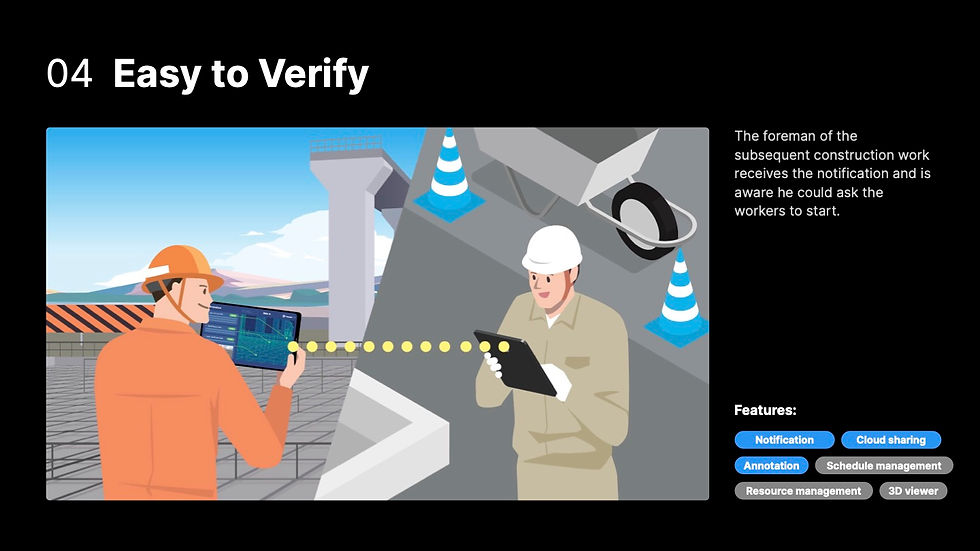
The reminder will pop up based on the survey schedule. Users can also check detailed information in the 3D view, share the necessary document with the surveyors, and assign tasks through CPS directly. When the survey is finished, CPS will notify the foreman to start the construction work.


Easy to Update
If the design does not match the actual situation and needs to be modified, the foreman can share the information from the construction site directly through comments or image annotations. The site lead can quickly catch up on the information and request the design department to modify the design. The updated design and related documents will be updated automatically.


Easy to Verify
CPS will notify the site lead when the final inspection is coming. It will provide an intelligent checklist based on the work plan. It also allows users to verify the design in AR mode to get a clear view of the difference between 3D model and the construction. The inspection result will update in CPS, and all the stakeholders can immediately check the latest status of the construction site.



Vision & Scope

With a well-defined objective in place, the remaining task is figuring out how to reach it. We held a thorough walkthrough of the storyboard with the client, discussing the necessary features for realizing the vision and establishing a development sequence. We further detailed every milestone and its respective functionalities and even laid out a proposed timeline for development.


Reflection

In our project with Obayashi Corp, we worked on solving key challenges in the construction industry by developing a platform aimed to streamline workflows and boost efficiency. However, the journey wasn't without obstacles.
Getting consensus among Obayashi's diverse departments, handling time differences for daily communication with the Japan-based team, managing both remote and on-site workshops for feedback and ideas, and overcoming language barriers with our Canadian members were some of the major challenges we encountered.
Despite these hurdles, we deeply understood the challenges faced by site supervisors, which informed the creation of our user-focused solutions such as an intelligent checklist and an AR mode.
These hurdles were learning experiences, highlighting the importance of adaptive problem-solving, effective inter-departmental communication, and user-centric approaches. The positive feedback from Obayashi Corp confirmed our efforts and direction. This project wasn't just about a platform, but about influencing an entire industry.
Comments