Live Chat Travel Agency Service Design
- Conversational commerce
- Jan 31, 2020
- 5 min read
Updated: Feb 17
Timeline: 2019.09-2020.02
Client: PKSHA Technology
Role: Design strategy, UI/UX design, Visual design
Brief
This project is a chat-based travel agency service aimed at tourists who are interested in traveling to Taiwan and Thailand. Travelers can interact with agents through chat apps like LINE, and are able to consult on and book travel-related products such as airline tickets and hotels. In this project, I served as the sole UI/UX designer from the initial stages, responsible for all aspects of UI and UX, including formulating a UX strategy using design thinking processes, creating visual designs, and conducting user tests. Despite being mainly operated by individuals with no experience in the travel industry and part-time crowd workers, we achieved a conversion rate (CVR) of over 14%, significantly exceeding the industry average of 5%. Additionally, we achieved high customer satisfaction, with a Net Promoter Score (NPS) more than five times the industry average.
Process
As the sole UI/UX designer on the team, and recognizing that others didn't have a thorough understanding of the UX process, I took the initiative to implement the design thinking process. Part of my motivation was to explore and validate the effectiveness of this approach in a chat-based service context.
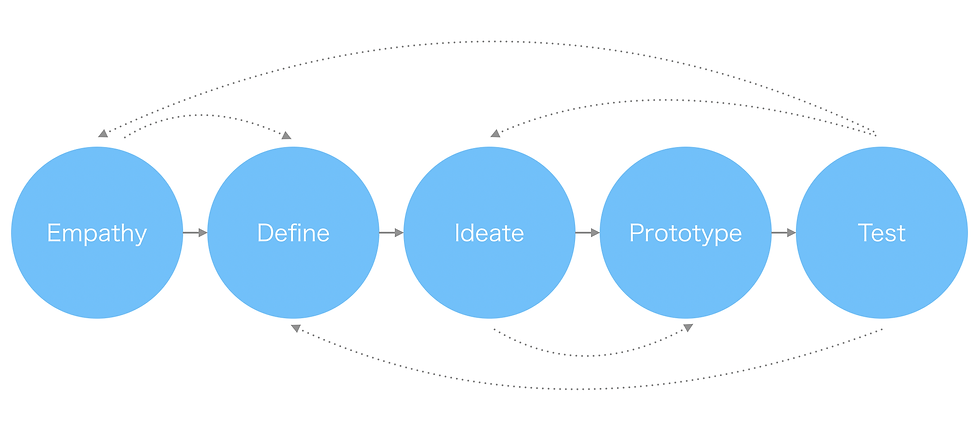
Design Thinking Micro Process
Empathy
Before I joined the team, the project had already been running a functional MVP for several months, providing us with valuable conversation logs. We reviewed around 50 of the most recent logs and used them to create persona sheets, which helped us understand the user context better.

Conversation Logs X 50 users

Persona Sheets X 50 users

Current User Factors Analysis
Upon analyzing the data, we discovered that users with no overseas travel experience and low technical expertise were most likely to book through our service, leading to the highest conversion rates. Based on this, we established three personas:
Core Target User: Possesses low technical expertise and has no overseas travel experience. We aim to achieve a 75% conversion rate with this group.
Main Target User: Also has low technical expertise but is planning their first trip to Taiwan or Thailand. Our goal is a 50% conversion rate for this persona.
Sub Target User: Planning to travel to Taiwan or Thailand, with a conversion rate goal of 15%.

Target User Goal Setting

Core Target User Persona

Main Target User Persona

Sub Target User Persona
Define
With clear business objectives and established personas from the empathy stage, we were now ready to define our users' problems and needs. We held a workshop to create user stories for each persona, allowing us to identify the challenges they were facing.

Storyboard Samples
Following the workshop, we collated the issues identified from all storyboards and created a customer journey map. This tool not only helped the team fully grasp the subjects but also facilitated brainstorming sessions aimed at developing solutions for our users' needs. We incorporated our findings into the point-of-view (POV) statement.

Customer Journey Map of the Core Target User

POV Statement
Ideate
With the customer journey map, the team now had a comprehensive understanding of the users' needs. The next step was to determine what functions would be necessary to meet these needs, and how the overall structure of the service should be designed. During a brainstorming session, we grouped all the functions together, which led us to identify four key roles for the travel agent: counselor, expert, secretary, and travel guide.

Brainstorming Result

Final Grouping
Design
The agent's role in this service is analogous to a concierge, handling all aspects of a customer's trip. To encapsulate this, I collected photos of concierges to create a mood board, aiming to evoke a sense of trust, elegance, and sophistication in our visual style.

Mood board
In Japanese culture, there's often resistance to displaying personal photos online. So, asking agents to show their photos to customers could be a challenge. However, there's a comfort level with interacting with virtual characters, as seen in games or animations. We therefore decided to incorporate hand-drawn, concierge-style characters into the UI to enhance the sense of humanity and make users feel more at ease while chatting online.

Virtual Concierges
When a new customer initiates a conversation, a chatbot automatically collects their requests to increase agent efficiency, providing an immediate response to reduce waiting time. The chatbot also records these requests in the CRM system, eliminating the need for agents to manually note them.

Image Samples of the Chatbot
We aimed to design travel products into dialogue bubbles, making them easier to browse and compare within the chat UI. I created three templates of dialogue bubbles to accommodate various uses.

Dialogue Bubble Design for Flights

Dialogue Bubble Design for Tourist Spots

Dialogue Bubble Design for Hotels, Local Tours, Restaurants
To foster trust in our agents, I designed a self-introduction card that agents could send to customers before starting a conversation. This card, which customers can click to view an agent's self-introduction and reviews, helps customers feel more at ease when chatting with the agent.

Agent page design
The final stage involves presenting the travel plan proposal, which includes details about flights, hotels, and other travel products chosen by the customer. The customer can review the proposal and proceed to payment if everything is satisfactory. Given the complexity of displaying this information within the chat UI, we designed it as a mobile web page instead.

Travel Proposal Page Design
Test
The testing stage of this service is considerably more straightforward than in typical UX projects, largely because we can directly contact users and gather feedback via chat. I designed four methods for collecting user feedback at different stages of the customer journey:
Feedback of abandonment: We collect reasons for user abandonment.
Feedback of proposal quality: We gather user responses regarding the quality of travel proposals provided by the agent.
Feedback of conversation quality: We collect user feedback on the quality of the agent's responses during conversations.
Feedback of satisfaction: We gather general feedback on the user's overall satisfaction with the service.

The Framework of Gathering User Feedback

Mockups of User Feedback Dialog
Result
Our service boasts an average Conversion Rate (CVR), or booking rate, of about 14%, which significantly exceeds the average rate for travel product websites (about 5%). This suggests that a live chat travel agency service is not only feasible but also highly effective. Many users prefer to directly discuss their needs when considering purchases, especially when the products in question involve complex choices, as is the case with travel products.

User satisfaction with our service is notably higher than the average within the travel service industry. Notably, our service received a perfect score from about 52% of users, which is over five times the industry average. This indicates that the human touch provided by our agents significantly enhances the user experience compared to a more impersonal website.

Comparison of User Satisfaction Score Rate
Reflection
In this project, I experimented with applying the design thinking process to a live chat travel agency service. I found that, with a few tweaks, it worked quite well. This experience also opened my eyes to the potential of conversational commerce. It offers a frictionless purchasing process and enhances the overall user experience. Additionally, the chat format inherently records conversation logs and allows for direct user contact, which greatly simplifies user analysis and testing. With the successful completion of this project under my belt, I feel confident that I can smoothly transition and apply this approach to other chat-based services.
Comments